
September 2026 Wellness Brief: Are You Missing These Critical Trends?
Monthly Workplace Mental Health & Wellness Newsletter.
Your Guide to Thriving Workplaces in Kenya and Beyond.
THE EXECUTIVE BRIEF
Kenya Focus
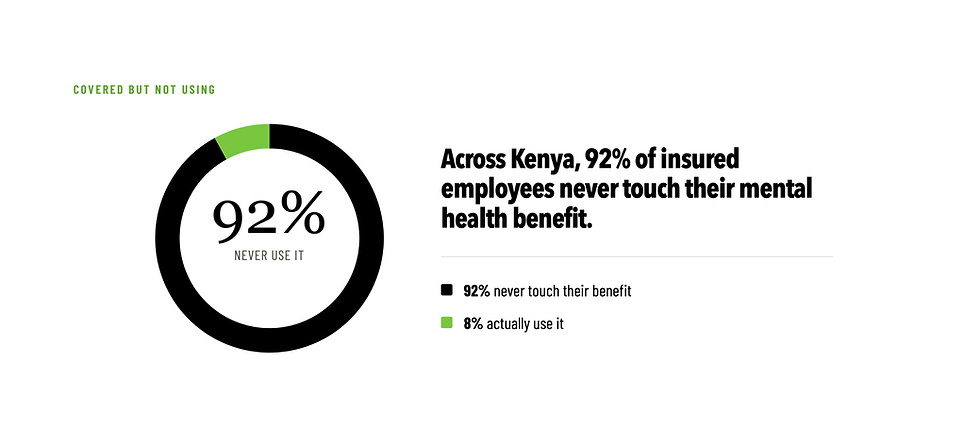
A persistent challenge across East African corporate environments is that organizations consistently invest in wellness benefits, only to see usage remain disproportionately low. Insights from over 35 years of supporting regional employers indicate that nearly 90% of employees with access to wellness programs never utilize them. This gap is driven primarily by workplace stigma, confidentiality concerns, and limited visibility rather than a lack of quality offerings.
The real priority for Kenyan employers is bridging this trust gap. Organizations deriving real value from their wellness investments treat communication and trust-building as continuous operational practices rather than single annual events.
Global Insights
International studies reinforce these local findings. Wellhub’s 2026 Work-Life Wellness Report, surveying over 5,000 professionals globally, shows that 86% of employees view workplace wellbeing as equal in importance to salary, with 89% reporting higher productivity when wellbeing is genuinely prioritized. Across all major research this year, health and wellness have shifted from optional perks to fundamental criteria candidates evaluate when choosing employers.
For organizations relying on isolated initiatives—such as periodic yoga sessions or annual wellness days—the takeaway is clear: one-off activities offer short-term value, but they cannot replace a trusted, systemic wellbeing strategy.
DATA SPOTLIGHT
The Menopause Shift: SHRM’s 2026 Employee Benefits Survey reports that 27% of US employers now offer dedicated menopause support, up from 18% the previous year. Mayo Clinic findings estimate menopause symptoms cost businesses billions annually in lost productivity and absenteeism. Targeted support is rapidly evolving from a niche benefit into a key retention strategy designed to keep experienced female leaders in the workforce.
The Four-Day Week Verdict: Research from Boston College published in Nature Human Behaviour tracked workers across 141 global organizations participating in six-month, full-pay four-day workweek trials. Employees experiencing reduced hours reported significant drops in psychological stress. The positive outcomes stem less from the extra day off and more from operational redesigns—such as eliminating unnecessary meetings, setting clear priorities, and granting greater autonomy.
The Financial Stress Line: 2026 workforce data reveals that over half of employees report high levels of personal financial anxiety, which directly impacts workplace concentration. In Kenya, financial pressure consistently ranks as the primary trigger prompting staff to utilize workplace support services.
TREND WATCH
From Wellness Perks to Organizational Design
Employers are increasingly treating manageable workloads, job autonomy, and supportive leadership as core wellbeing interventions, using resilience training as a secondary supplement.
Menopause Support as a Retention Strategy
Tailored reproductive health and menopause programs are expanding rapidly to preserve institutional knowledge and retain senior talent.
Proactive Mental Fitness Over Reactive Crisis Response
Organizations are equipping managers to identify early indicators of burnout and embedding routine wellness check-ins to prevent issues before they reach a crisis point.
AI and Workplace Anxiety as a Named Risk
Accelerated technology integration has introduced documented workplace anxiety linked to job security and performance monitoring. Addressing the human impact of AI deployment is now critical to preventing downstream burnout.
EXPERT INSIGHTS
"Your human resource is your principal resource and your most adaptable one. If you do not protect wellbeing, that resource is exhaustible."
— Professor Kevin Fong OBE, Science Broadcaster and Emergency Medical Doctor
"Leading organizations are transitioning from isolated wellbeing programs to systemic integration, embedding wellbeing into operating models, leadership capability, workflow design, and performance management."
— Jessica Grossmeier, Researcher and Global Wellness Institute Workplace Wellbeing Initiative Chair
A CLOSER LOOK: FINANCIAL WELLNESS AS A CASE FOR ACTION
PayPal’s financial wellness framework, introduced under Dan Schulman in 2019, remains a clear example of structural workplace intervention. By assessing employee net disposable income, increasing base pay for entry-level roles, extending stock options broadly, and offering targeted financial coaching, the company achieved measurable gains in staff retention and engagement.
Financial distress directly impacts health and organizational performance. Addressing it effectively requires structural commitments alongside traditional employee assistance hotlines.
PRACTICAL TOOLS
Establish a Clear Right to Disconnect: Outline explicit availability boundaries, encourage scheduled email delivery during off-hours, and shift team communication from personal channels like WhatsApp to professional platforms. A concise internal policy enforced by leadership provides an immediate starting point.
Audit the Physical Environment: Simple workspace adjustments—maximizing natural light, adding greenery, and creating quiet focus zones—provide low-cost, evidence-based methods to enhance concentration and reduce workplace stress.
Formalize Wellness Action Plans: Standardize procedures for flexible working arrangements and workload adjustments to ensure equitable decisions across all departments.
ASK THE EXPERT
Q: What is the difference between a mental health policy and a wellbeing strategy?
A: A policy serves as a foundational safety net, defining compliance, roles, and emergency procedures when issues occur. A strategy is a proactive blueprint that designs work environments to prevent burnout before it develops. Most organizations possess a policy; far fewer execute an active strategy.
Q: Our employees are stressed but hesitate to use existing benefits. How do we address this?
A: This indicates a gap in trust rather than awareness. Stressed employees frequently worry about confidentiality and potential career impacts. Overcome this by consistently communicating how privacy protections operate within your programs rather than relying on a single mention during onboarding.
Looking Ahead
The organizations that successfully retain top talent this year will be those that foster strong internal trust. Ensuring employees feel confident using existing wellness benefits remains the single most impactful step before introducing new initiatives.
Connect with OAW: +254 725 366 614 | admin@oasisafrica.co.ke |


Comments