
July 2026 Wellness Brief: What's Actually Changing in Workplace Wellbeing
Wellbeing stopped being a perk a while back. What's shifting now, midway through 2026, is how organisations are expected to prove it works. Boards want outcomes, not initiatives. Employees want support that fits their actual lives, not a poster in the break room. This month, we look at where the evidence is solid, where it's still catching up, and what that means for teams here in Kenya and across the region.
THE EXECUTIVE BRIEF
Kenya Focus
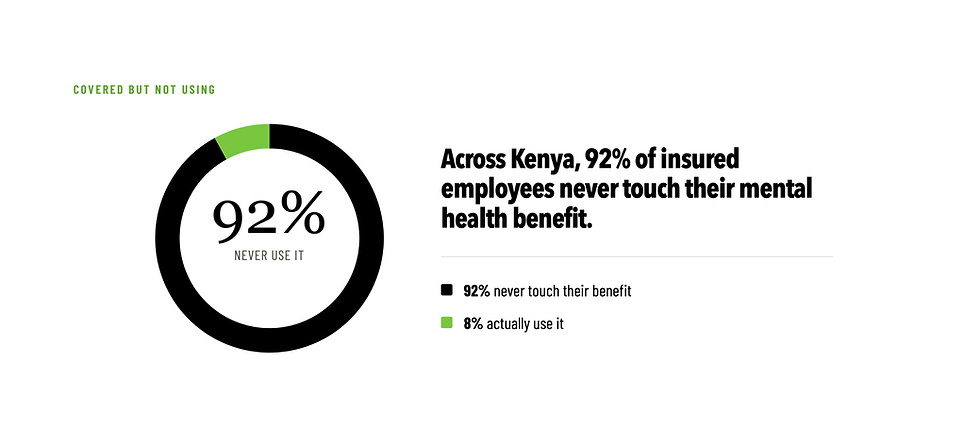
Digital wellness tools built for local context, not imported wholesale from elsewhere, are starting to close real gaps in access. That matters in a market where the nearest qualified practitioner might be a two-hour matatu ride away, and where stigma still keeps people from walking through a clinic door in the first place. HR leaders across the region are also paying closer attention to how wellbeing support holds up across generations in one household, from a young graduate managing student debt to a parent covering school fees and caring for aging relatives at the same time.
Global Insights
The bigger story worldwide is that wellbeing programmes are being asked to earn their keep. Harvard Business School's 2026 research on workplace wellbeing outcomes has been blunt about this: many programmes still don't move the needle on the metrics leadership actually cares about, and the gap is usually a design problem, not an effort problem (Harvard Business School, 2026). That's not a reason to retreat from wellness investment. It's a reason to be far more deliberate about what gets funded and why.
DATA SPOTLIGHT
Burnout remains the headline concern going into the second half of 2026, and remote and hybrid teams are carrying a disproportionate share of it, tied largely to isolation and the erosion of any real boundary between work and home (John, 2026; Franco, 2026).
TREND WATCH
NeuroWellness
Attention to the nervous system, not just the mind in the abstract, is showing up more in how organisations design support. Short, practical resets during the working day are gaining traction less as a wellness trend and more as basic performance maintenance (Global Wellness Institute, 2026).
The Women's Health Conversation
More employers are formalising policies around menopause and broader women's health needs, treating this as a retention issue rather than a niche accommodation. The logic is straightforward: women in the middle of their careers, often at the height of their institutional knowledge, are the ones most affected, and losing that experience is expensive in ways that don't always show up on a balance sheet until it's too late.
AI and the Anxiety It's Creating
AI-enabled personalisation, tools that tailor stress support or nutrition guidance to an individual, is moving from pilot project to expected feature. But the same technology is a genuine source of workplace distress. Survey data this year links employee AI involvement directly to measurable distress (People Matters, 2026), and WTW's 2026 analysis of AI in workplace mental health makes the same point from a different angle: rollout without transparency does more harm than the technology itself (Young, 2026).
PRACTICAL TOOLS
Virtual body-doubling — working alongside someone, human or digital, to support focus. Particularly useful for neurodivergent employees managing task initiation (Westover, 2026).
Task chunking — breaking large pieces of work into smaller, defined steps with interim checkpoints, reducing the cognitive load of an open-ended project.
The withdrawal principle — giving people a genuine, respected way to step back from always-on communication without penalty. The EU's move to formalise this kind of boundary in digital regulation this year is worth watching as a signal of where policy, not just culture, is heading (REVER, 2026).
ASK THE EXPERT
Q: How do we address rising anxiety about AI among our staff?
A: Start with honesty. Most employees already expect AI to change their jobs, and pretending otherwise erodes trust faster than the change itself. Give people a clear roadmap, involve them in evaluating the tools before they're rolled out, and treat AI adoption as a wellbeing issue sitting inside your HR strategy, not a side conversation happening only in IT (Young, 2026; People Matters, 2026).
A LONGER VIEW: THE PAYPAL PRECEDENT
It's worth remembering that some of the strongest evidence for treating financial wellbeing as core business strategy isn't new. Several years ago, PayPal restructured its approach to employee compensation and financial support after discovering that many of its own hourly and entry-level staff were struggling to make ends meet, despite being paid at or above market wages. The company reduced healthcare costs, extended stock awards across all levels, and built ongoing financial education into its benefits. Engagement scores climbed into the top five percent of benchmarked technology companies as a result. The lesson holds in 2026 as much as it did then: financial stress is a wellbeing issue, and it responds to structural fixes, not just messaging.
LOOKING AHEAD
The four-day work week has moved from fringe experiment to a live policy conversation in several markets this year, with 2026 research offering the clearest evidence yet that reduced hours can hold productivity steady when paired with genuine process redesign (Speakwise, 2026; SUCCESS Staff, 2026). Whether that translates directly to the Kenyan context is a separate question, one worth watching rather than assuming.
References
AllOne Health. (2025, December 15). The EAP revolution: AllOne Health's 2026 trend report unveils the modern, high-impact support your workforce needs now.
BrightPlan. (2026). What's next for employee wellness? 6 key trends for 2026.
CoreHealth Technologies. (2026). 5 employee wellness trends in 2026.
EPIC. (2026). 2026 workplace wellness trends: Insights for employers.
European Agency for Safety and Health at Work (EU-OSHA). (2026). Together for mental health at work – Campaign guide 2026–2028.
Franco, D. D. (2026, March 16). Employee burnout statistics (Guide for 2026). Meditopia for Work.
Global Wellness Institute. (2026). Initiative trends 2026.
Global Wellness Institute. (2026, April 7). Workplace wellbeing initiative trends for 2026.
Harvard Business School. (2026). Why workplace well-being programs don't achieve better outcomes.
John. (2026, June 27). Remote work burnout statistics 2026: The data. Nomad Blog (Staywise).
Johnson & Dugan. (2026). 5 employee wellness trends to watch in 2026.
make a difference. (2026, June). Inside the market: Workplace wellbeing trends shaping employee health and benefits in June 2026.
People Matters. (2026). 'Employee distress driven by AI involvement in workplace': Survey.
Pleaz. (2026). Top 10 employee well-being platforms in 2026.
Radevska, I. (2026). Workplace wellness trends report for 2026. Shortlister.
REVER. (2026, March 23). EU withdrawal button law (June 2026): What the new EU e-commerce regulation means for online returns.
Saudi Vision 2030. (2026). Quality of life program.
Seaverson, E. (2026, June 23). 2026 workplace wellness trends you need to know. WebMD Health Services.
Speakwise Team. (2026, April 2). Four-day workweek statistics 2026: Results.
Standard Chartered. (2026, March). Redefining wealth through health and wellness.
SUCCESS Staff. (2026, April 3). The 4-day work week in 2026: What the research actually shows. SUCCESS Magazine.
Wellable. (2026). 2026 employee well-being industry trends report.
WellSteps. (2025, November 5). Employee wellness trends 2026: What employers need to know.
Westover, J. H. (2026, March 19). Neurodiversity in the workplace: A comprehensive examination of organizational practices supporting neurodivergent employee wellbeing. Preprints.org.
Young, E. (2026, April 6). AI in workplace mental health: Navigating opportunity and responsibility. WTW.

Comments