
October 2026 Workplace Wellness Brief: One year of mental health cover under SHA: what has changed at work?
THE EXECUTIVE BRIEF
Kenya: On 8 October 2025 the Ministry of Health announced that mental health services had been added to the Social Health Authority benefits package under the Taifa Care Model. It was the first time mental health sat inside national health insurance. This Thursday marks one year, and World Mental Health Day follows on Saturday 10 October.
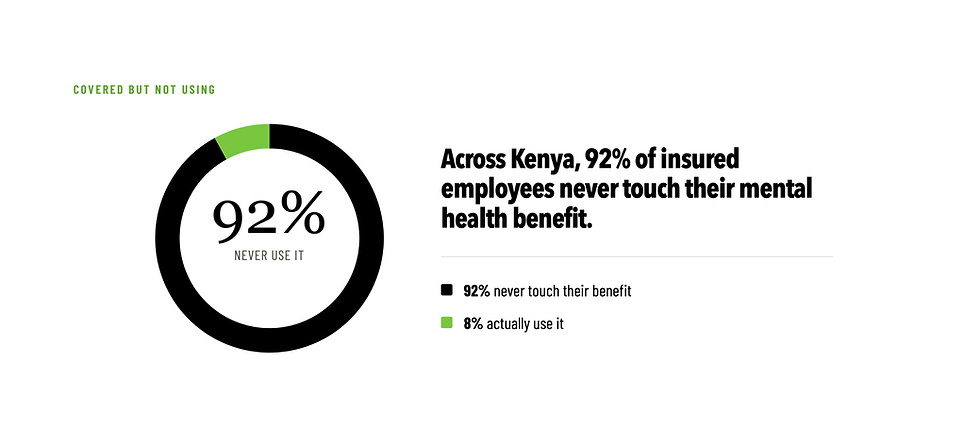
Cover on paper has not become care in practice. Across the employers we work with, use of mental health benefits stays low. The reasons staff give are consistent: worry about who will find out, not knowing how to access support, and leaders who never mention it.
Global: The conversation has moved from offering access to proving it is used and that it helps. ISO 45003, the international guidance standard on psychosocial risk published in 2021, gives boards a voluntary but recognised way to treat workload, role clarity and support as health and safety matters.
DATA SPOTLIGHT
US$4 back for every US$1: A WHO-led study (Lancet Psychiatry, 2016) estimated this return, in better health and productivity, from scaling up treatment for depression and anxiety. It is a global model, not a forecast for any one company.
US$1 trillion a year: WHO's estimate of what depression and anxiety cost the global economy in lost productivity.
TREND WATCH
Work design alongside personal resilience: Coping skills matter, but they cannot carry a team through chronic understaffing or unclear decision rights. Stronger programmes address both.
Managers as the first line: Most staff will tell a supervisor before they call a counsellor. Managers need to spot early signs, hold a decent conversation and know where to refer.
Financial stress as a wellbeing issue: Money worries follow people to work. Debt counselling and budgeting sessions are becoming part of wellness programmes.
Midlife health: Menopause and healthy ageing are entering policy conversations as careers lengthen.
Monitoring tools, with caution: Platforms now offer to flag burnout from staff data. Under Kenya's Data Protection Act, 2019, health data is sensitive personal data. Tracking can deepen the confidentiality fears that keep people away.
OUR VIEW
A counselling line cannot repair a workplace that keeps producing the same distress. Imported wellness templates also miss what shapes working life here: extended family obligations, financial pressure, faith and community. Support has to be built for the people using it.
SUCCESS STORY
Kijabe Hospital: they asked, then they acted
In March 2020, two weeks after Kenya confirmed its first COVID-19 case, staff at AIC Kijabe Hospital were frightened and stretched. The hospital, a faith-based facility about an hour and a half from Nairobi, did not start with a wellness campaign. It started by listening.
Leadership set up a series of debriefing sessions for frontline staff. Two design choices mattered:
Neutral facilitators: The sessions were run by a community-based team that worked outside the hospital walls, so staff saw them as neither management nor colleagues.
Nothing recorded: Sessions were not recorded, to protect confidentiality.
What staff said went straight to decision-makers, and things changed: staff schedules, transport arrangements and COVID-19 training were all adjusted in response.
The lesson for any employer: people speak up when they trust the room, and they keep speaking up when they see something change.
Source: Coping with COVID, American Journal of Tropical Medicine and Hygiene, 2021.
PRACTICAL TOOLS
Listen first: Run an anonymous staff survey before allocating budget. With small teams, report only organisation-wide results so nobody can be identified.
Train your managers: Cover basic mental health literacy, check-in conversations, warning signs and a clear referral route.
Make access simple and private: State in plain language who sees what, and where confidentiality has limits. Have a senior leader talk openly about the service.
Protect recovery time: Short breaks and meeting-free blocks are cheap to try.
Know your emergency route: Every employee should know who to call when someone is at immediate risk. That is separate from a routine referral.
ASK THE EXPERT
Question: "Our leadership sees wellness as an HR cost with low participation. How do we change that?"
Answer:
Start with your own numbers. Sick days, turnover and exit interview themes persuade a finance director faster than any global statistic.
Use the WHO evidence as context. The 4 to 1 return shows treatment pays back at scale. It is not a promise for your organisation.
Treat low usage as a design problem. Ask what is in the way: privacy, awareness or leadership silence.
Frame it as risk. ISO 45003 lets you raise psychosocial risk in the same language as any other health and safety exposure.
LOOKING AHEAD
Rwanda hosts the 7th Global Ministerial Mental Health Summit in Kigali on 30 and 31 March 2027.
SHA in year two: employers should watch how the benefit works in practice, and what it means for the cover they already fund.
For anything EAP related, email Brian Cheruiyot at brian@oasisafrica.co.ke.


Comments