
November 2026 Wellness Brief
Kenya is coping better than its neighbours. Four in five workers still aren't thriving.
Each month we read the global research on workplace mental health and ask one question of it: what does this mean for an employer in Kenya? This month the answer is more hopeful than usual, and harder to wave away.
Gallup's newest data puts Kenyan employees ahead of the Sub-Saharan average on stress, anger and engagement. That is real progress. But only 21% of Kenyan workers say they are thriving in their lives, against 34% worldwide. The gap is no longer about crisis. It is about the everyday weight people bring to work, and whether anything at work helps them set it down.
Below: what the world's research is saying, and how each finding shows up, or could show up, in a Kenyan workplace.
1. The executive brief
The global picture
Only one employee in five worldwide is engaged at work, according to Gallup's 2026 State of the Global Workplace. The same report puts the cost of low engagement at roughly US$10 trillion in lost productivity, about 9% of global GDP.
In the US, SHRM's 2026 Mental Health Snapshot, based on a February survey of more than 1,000 HR professionals and 1,100 workers, points to rising burnout alongside mental health benefits that too many people leave unused.
That gap is driving a rethink. Vendors such as Lyra Health argue the old model, where support switches on only once someone is in crisis, has reached its limit. We agree with half of that. An employee assistance programme that waits at the end of a phone line will always be underused. One that shows up earlier, in training, in managers' habits and in how work is designed, gets used.
The money backs this up. Deloitte's latest UK analysis puts the return at roughly £4.70 for every £1 employers spend on mental health, with the biggest returns coming from early, organisation-wide measures rather than late-stage care.
The Kenya picture
Kenya's 2026 Gallup numbers are better than you might expect:
Engaged at work: 21%, against 19% across Sub-Saharan Africa and 20% globally
Stressed a lot of the previous day: 33%, against 46% regionally and 40% globally
Lonely a lot of the previous day: 26%, slightly below the region (28%) but above the world (22%)
Thriving in life: 21%, against 18% regionally and 34% globally
So Kenyan workers are coping. They are just not flourishing. And the reasons sit as much outside the office as inside it.
Money is the big one. Old Mutual's latest Financial Wellness Monitor finds 43% of Kenyan workers financially stressed. An earlier Old Mutual survey found 46% of Kenyan adults supporting both their children and their parents. When half your mind is on school fees and a parent's hospital bill, the other half is doing your job. That is presenteeism, and it rarely shows up in an absence report.
The national cost is already counted. Kenya's mental health investment case estimated KSh 62.2 billion lost in 2021 to absenteeism, lower productivity and care costs.
2. Data spotlight
Three benchmarks worth knowing this quarter, and what each looks like from a Kenyan HR desk.
What it measures | Global benchmark | Source | What it means in Kenya |
Return on investment | About £4.70 back for every £1 spent (UK) | Deloitte, 2024 | Kenya lost KSh 62.2 billion in 2021 to poor mental health |
Health cover costs | US family premiums up 5% to $28,303; single cover $9,804. Wages rose 3.7%, inflation 2.7% | KFF Employer Health Benefits Survey, 2026 | Medical cover costs are rising faster than pay here too. Prevention is cheaper than claims |
Engagement and wellbeing | 20% of employees engaged; 34% thriving in life | Gallup, 2026 | Kenya: 21% engaged, 21% thriving |
Kenya matches the world on engagement. The gap is in how people feel about their lives outside the job, which is exactly what follows them into it.
3. Trend watch
Five shifts are reshaping workplace mental health around the world. Here is each one, and where we see it landing in Kenya.
1. Fixing the work, not just the worker
Globally, employers are moving from asking staff to be more resilient towards changing what wears them down: impossible targets, unclear roles, managers who never check in. Lyra Health's 2026 trends report and much of the occupational psychology literature now frame this as work design.
In Kenya: the Occupational Safety and Health Act 2007 already places a general duty on employers to protect workers' health. ISO 45003, the international guideline on psychological health at work, gives HR teams a practical way to treat workload and role confusion as workplace hazards under that duty.
2. AI is adding pressure, not only saving time
The Global Wellness Institute and Lyra both report rising anxiety about AI among employees, and a sense that leaders underestimate the strain it adds.
In Kenya: banks, telcos and Nairobi's outsourcing and contact-centre sector are adopting automation fast. Staff hear about AI long before anyone explains what it means for their role. That silence is where the anxiety grows.
3. Financial health is becoming a benefit
Employers abroad are adding savings schemes, earned-wage access and debt advice to their wellness offer, because money worry follows people to their desks.
In Kenya: we are ahead here without always noticing it. Workplace SACCOs already give many staff savings and affordable credit. Pairing them with honest financial education turns an existing benefit into a mental health one.
4. One size no longer fits
Aon and CoreHealth both find younger workers expect support that fits their lives: sleep, focus, neurodiversity, fertility and menopause care among them.
In Kenya: our workforce is young, and Gen Z employees talk about mental health more openly than their managers did at their age. A single annual wellness day will not meet them where they are.
5. Control over time matters as much as place
Owl Labs' 2026 US report describes a growing preference for microshifting, working in non-linear blocks around personal and family needs, and links structured hybrid policies with lower staff turnover.
In Kenya: Nairobi traffic and the school run already shape the working day. Flexible start times can give back hours of commuting stress. For frontline roles that cannot flex, predictable rotas and fair shift-swaps do the same job.
4. Expert insights
Two clinical leaders at Lyra Health, Dr. Joe Grasso and Dr. Alethea Varra, make the same case in this year's trends report. Complex mental health needs and mental health-related leave are both rising. Personal resilience alone is not holding up under economic and technological uncertainty. Most of what employers do is still reactive, arriving only once a person or their family has reached a crisis.
Organisational psychology has a simple model for why. The Job Demands-Resources model sets two things against each other:
Demands: workload, time pressure, emotional strain
Resources: a supportive manager, some control over your work, flexibility, access to help
When demands outrun resources for long enough, people burn out and pull away. When resources keep pace, engagement rises and people stay.
Our view at OAW. The critics of employee assistance programmes are describing a programme that waits by the phone. That model deserves to struggle. An EAP works when it adds to the resources side of the scale every week, not only in a crisis: managers who know how to start a hard conversation, teams that have had a workshop on stress before the busy season, staff who already know what a first session looks like. That is the kind of EAP we build with Kenyan employers.
5. Success stories from Kenya
Two Kenyan examples, one corporate and one clinical, show the global trends already working here.
Safaricom: taking family pressure off working parents
Kenyan law gives mothers three months of paid maternity leave. Safaricom gives four, then six months of flexible hours on return, and runs an on-site nursery at its Nairobi headquarters staffed by trained carers. The point is not the perk. It is that a new parent's biggest worry is handled before it reaches their desk.
An IFC case study of the programme makes the business argument directly: employer-supported childcare strengthens the bottom line, not only the employer brand.
AIC Kijabe Hospital: listening fast when staff are stretched
In the early months of COVID-19, AIC Kijabe Hospital, a faith-based referral hospital in rural Kenya, needed to know how its frontline staff were coping, and quickly. A team led by Dr. Mary Adam ran a series of short debrief sessions with nurses, lab staff, cleaners and administrators.
Staff wrote their answers on sticky notes on a flip chart: how they were coping personally, and what they needed from the hospital. Notes carried no names, which protected confidentiality. Management reviewed what came in every day and acted on it, changing rotas, supplies and support. By the third week, demand for the sessions had eased.
The lesson for any employer: you do not need an expensive survey to find out what is hurting your people. You need a safe way to ask, and the discipline to respond within days, not quarters. The study was published in the American Journal of Tropical Medicine and Hygiene.
6. Practical tools
Five things an HR team in Kenya can start this quarter, most of them at little cost.
Give managers a script. Most staff will mention a struggle to their line manager long before they call anyone else. Train managers to notice the early signs (someone going quiet, missing deadlines they used to hit, pulling away from the team) and to open a supportive conversation without diagnosing. OAW's Manager wellbeing fundamentals sessions are built for exactly this.
Measure strain like any other workplace hazard. Use ISO 45003 as your frame, and a validated questionnaire rather than a generic morale survey. The Organisational Health Improvement Questionnaire (OHIQ-Core), published as a preprint this year, is one new option; it has not yet been through peer review. Check in quarterly.
Run short, safe debriefs in high-pressure teams. Fifteen minutes, the Kijabe way. Two cautions: in a team of six, handwriting or a single comment can identify someone, so pool small teams together; and anything collected digitally about staff health counts as sensitive personal data under Kenya's Data Protection Act 2019.
Turn the SACCO into a wellbeing benefit. Partner with your SACCO or a reputable provider on financial education and debt advice, not just loans.
Protect focus time. Set a company-wide no-meeting block, such as Friday afternoon, and write down how flexible start times work so managers apply them fairly.
If someone is in immediate danger. None of these tools replaces emergency help. If a colleague is at risk of harming themselves or someone else, call 999 or 112, or take them to the nearest hospital, and stay with them. Then call OAW on 0725 366 614 for follow-up support.
7. Ask the expert
Answers from the OAW clinical team.
How do I make the case for a mental health budget when finance wants cuts?
Talk about risk and cost, not kindness. Poor mental health already costs you money; it is just spread across sick days, resignations, recruitment and work done badly. Kenya counted KSh 62.2 billion of that loss in 2021. Deloitte's research puts the return on well-run programmes at several times the spend, and it is highest for early, preventive work. Bring finance those numbers alongside your own absence and turnover figures, and the conversation changes.
We have an EAP, but hardly anyone uses it. What are we doing wrong?
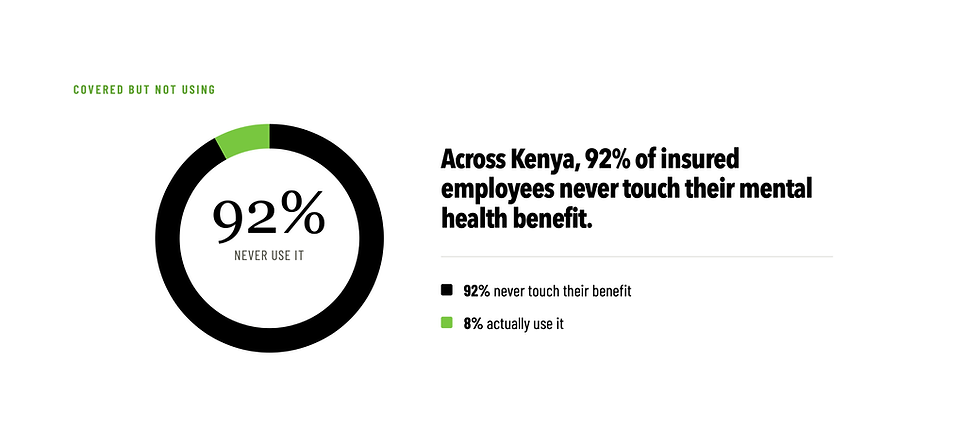
Low usage almost never means your people are fine. It usually means they don't trust it is private, don't know what happens when they call, or worry their manager will find out. Fix those three things. Tell staff plainly what you as the employer do and do not see. Walk them through what a first call actually involves. Train managers to mention the service as normally as they would mention medical cover. Usage follows trust.
Our teams are anxious about AI. How should leaders handle it?
Say more, sooner. Anxiety grows fastest in the gap between rumour and announcement. Tell teams what is being automated, what isn't, and what support exists for people whose roles change. Involve them in deciding how new tools fit their day. And treat AI-related strain the way ISO 45003 treats any other source of stress at work: as a risk you assess and manage, not a mood to ride out.
8. Looking ahead to 2027
Kenya goes into 2027 with workers who are coping better than most of the continent and thriving less than most of the world. Closing that gap will not come from another poster campaign. It will come from managers who know what to say, work that is designed for real people, and support that staff trust enough to use.
Many organisations will also restructure in the year ahead. The people who leave get attention. The people who stay often get none, though they carry the extra workload and the worry about who is next. We will return to them in coming issues.
Talk to us. For EAP enquiries, contact Brian Cheruiyot at brian@oasisafrica.co.ke.
To book a session, call or WhatsApp OAW on 0725 366 614.


Comments